Types of Nursing Homes: What Each Kind Offers and How to Tell Them Apart
Nursing homes cover more ground than the name suggests. Here is a breakdown of the main types, what each one specializes in, and how to know which fits your parent's situation.
The phrase "nursing home" gets used as a catch-all for any facility that provides care to older adults who can no longer live independently. In practice, the category covers several distinct types of facilities, each with a different purpose, care model, staffing structure, and cost profile.
Knowing the difference between types of nursing homes matters practically: a facility that is excellent for short-term rehabilitation after a hip replacement may not be the right setting for a parent who needs years of consistent, memory-sensitive custodial care. Understanding what each type offers helps families ask the right questions and match the setting to the actual need.
Traditional Skilled Nursing Facilities
A traditional skilled nursing facility, often abbreviated SNF and pronounced "sniff," is what most people picture when they hear "nursing home." These are licensed, state-regulated facilities that provide 24-hour supervised care for residents with chronic health conditions, significant physical limitations, or complex medical needs that cannot be managed at home or in an assisted living setting.
Skilled nursing facilities are staffed by registered nurses around the clock and include licensed practical nurses, certified nursing assistants, physical therapists, occupational therapists, speech therapists, and social workers. The medical level of care is higher than in assisted living, and residents typically require ongoing management of conditions such as advanced heart failure, diabetes complications, severe mobility limitations, or post-surgical recovery with continuing wound care.
Traditional SNFs accept Medicare, Medicaid, and private pay. Medicare covers a limited short-term skilled stay following a qualifying hospital admission; long-term custodial care in a SNF is predominantly a Medicaid-funded benefit for those who qualify or a private-pay expense for those who do not.
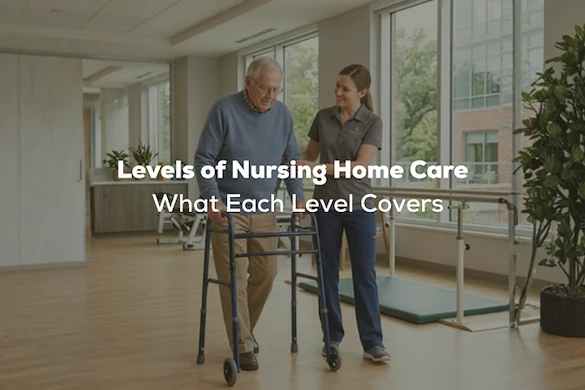
For a detailed breakdown of what care levels a skilled nursing facility covers, see Levels of Nursing Home Care: What Each Level Covers.
Short-Term Rehabilitation Facilities
Short-term rehabilitation facilities are often physically located within a skilled nursing facility, but they function as a distinct care program with a specific purpose: getting someone back on their feet after a hospital stay, surgery, or acute medical event.
The most common admissions to short-term rehab are post-joint-replacement recovery, stroke recovery, hip fracture recovery, and cardiac event rehabilitation. The emphasis is on intensive daily therapy, typically physical therapy, occupational therapy, and speech therapy in combination, with the goal of restoring as much function as possible so the resident can return home or to a less intensive care setting.
Medicare Part A covers short-term skilled nursing and rehabilitation for up to 100 days following a qualifying hospital stay of at least three inpatient days. Coverage decreases substantially after day 20. Most people in short-term rehab are there for 20 to 30 days; some complex cases extend further.
For more detail on how short-term rehab works, see A Guide to Skilled Rehabilitation for Seniors.
Memory Care Nursing Homes
Some skilled nursing facilities operate dedicated memory care units or wings for residents with Alzheimer's disease or other forms of dementia who also have significant medical needs. These differ from standard memory care communities (which are typically assisted living-level settings) in that they provide a higher level of medical oversight alongside the dementia-specific programming and environmental design.
A memory care unit within a nursing home is appropriate for someone whose dementia has progressed to a stage where both behavioral management and significant medical care are needed simultaneously. This includes residents who are nonverbal, require total assistance with all activities of daily living, have feeding complications, or have co-occurring medical conditions that require skilled nursing attention.
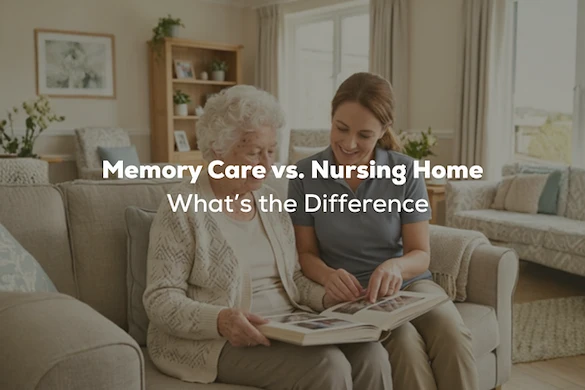
For families navigating the difference between memory care and a traditional nursing home, see Memory Care vs. Nursing Home: What's the Difference.
Continuing Care Retirement Communities (CCRCs)
A continuing care retirement community, commonly called a CCRC or life plan community, is a campus that offers multiple levels of care in a single location. A typical CCRC includes independent living cottages or apartments, an assisted living building or wing, a memory care unit, and a skilled nursing facility on the same grounds.
The appeal of a CCRC is continuity: a resident can move from independent living to assisted living to skilled nursing without leaving the same campus, familiar staff, and established social connections. For couples at different care levels, a CCRC may allow them to remain on the same campus even if one person needs skilled nursing while the other lives independently.
CCRCs typically require a substantial entrance fee, often ranging from tens to hundreds of thousands of dollars, plus monthly fees. The entrance fee structure varies significantly: some are partially refundable, some are not. Families considering a CCRC should review the financial model carefully and, ideally, have an independent financial advisor review the contract before signing.
Subacute Care Facilities
Subacute care sits between hospital-level care and traditional skilled nursing on the intensity-of-care spectrum. Subacute units handle patients who are medically stable but still require a level of clinical monitoring and treatment that exceeds what a standard skilled nursing facility provides.
Common subacute care scenarios include wound care for complex surgical or pressure wounds, IV therapy, ventilator weaning, and post-surgical monitoring for high-acuity procedures. Subacute care units may be freestanding or located within a skilled nursing facility or hospital.
Subacute care is typically a short-term setting. The goal is to stabilize and treat until the patient can step down to a lower acuity environment such as standard skilled nursing, assisted living, or home with home health support.
VA Community Living Centers
The Department of Veterans Affairs operates a network of care facilities called Community Living Centers, formerly known as VA nursing homes. These are available to eligible veterans and provide the full range of skilled nursing care, rehabilitation, and long-term care at no cost or low cost depending on the veteran's eligibility tier.
Veterans who served during wartime may also qualify for VA benefits that can be applied toward costs at non-VA nursing homes. Eligibility rules and benefit amounts vary, and families should work directly with a VA benefits counselor or an accredited Veterans Service Officer to determine what is available.
How to Choose the Right Type
Matching a parent to the right type of nursing home starts with the care need, not the facility name or price. A few questions to work through:
-
Is this a short-term stay or is long-term placement likely? Short-term rehab facilities are optimized for recovery and discharge. A traditional SNF is designed for longer stays.
-
What is the primary medical need? Wound care, IV therapy, or ventilator weaning points toward subacute. Memory-sensitive care alongside medical complexity points toward a memory care nursing unit.
-
Is it important to stay on the same campus long-term, even if needs change? That is an argument for a CCRC.
-
Is the veteran status a factor? VA Community Living Centers or VA benefits applied to private facilities may change the calculus significantly.
For questions to ask during a nursing home tour, see Questions to Ask at Skilled Nursing Facility Tours.
Common Questions
Technically, "skilled nursing facility" is the Medicare and Medicaid designation for a licensed nursing home that qualifies for federal reimbursement. In everyday usage, the terms are interchangeable. All SNFs are nursing homes; all nursing homes certified for Medicare and Medicaid are SNFs.
Yes. Nursing homes can decline admission based on their ability to meet the care need. A facility that is not equipped for ventilator care or does not have a secured memory care unit can appropriately decline an applicant who requires those things. Homes also have the right to discharge residents if the level of care need changes in a way they cannot accommodate, with proper notice and discharge planning.
Not exactly. Many skilled nursing facilities include a short-term rehabilitation program, but a freestanding rehabilitation center is typically a higher-intensity medical setting focused on recovery from specific acute events such as stroke or traumatic brain injury. These are sometimes called inpatient rehabilitation facilities, or IRFs. They have physician coverage requirements and therapy intensity standards that exceed what a standard SNF rehab unit provides.
Find Skilled Nursing Facilities Near You
Senior Care Finder provides a free, ungated directory of skilled nursing facilities and nursing homes across the U.S. No referral fees, no sign-up. Search, compare, and contact providers directly.