How to Talk to a Parent About Assisted Living and Keep Them in Control
You know the conversation needs to happen. Here is how to open it, what to say and avoid, and how to keep your parent in the driver’s seat the whole way.
You have probably already noticed the things that worry you: the unopened mail, the empty refrigerator, the stairs that seem steeper every visit. Recognizing that a parent may need more support is one thing. Actually saying it out loud to them is another, and for most families it is the harder of the two.
If you are dreading this conversation, that is normal. It touches independence, identity, and a house full of memories. The good news is that families have this conversation every day, and it goes best when it is treated as the first of many talks, not a single announcement. Here is a way to approach it.
Before You Bring It Up: Get Clear on the Goal
The goal of the first conversation is not a decision. It is an open door.
That single reframe takes most of the pressure off. You do not need your parent to agree to tour a community, pick a move date, or even accept that anything has to change. You only need them to know what you have noticed, that you are on their side, and that you want to figure it out together.
It helps to do a little homework first, quietly. Understand what assisted living actually is so you can answer questions accurately, because your parent’s mental picture may be a hospital ward from decades ago rather than the private apartments, restaurants, and social calendars that are typical today. Know roughly what options exist in the area they would want to stay near. You are not building a sales pitch. You are making sure that when they ask a question, you do not have to say "I don’t know" to all of them.
Pick your moment and your messenger. A calm afternoon beats a holiday dinner, and a one-on-one talk beats a family intervention. If one sibling has the smoothest relationship with your parent, it is fine for that person to open the topic, as long as everyone agrees on the goal: an open door, not a verdict.
How to Open the Conversation, and What to Say
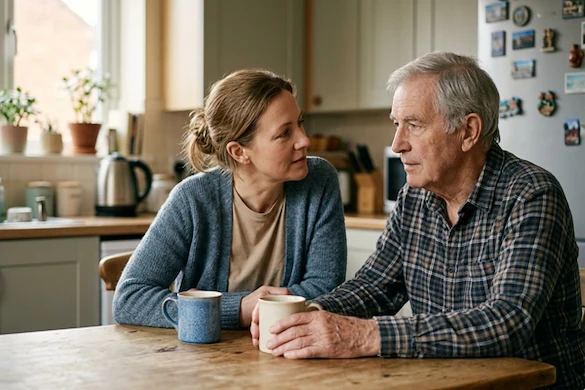
Lead with what you have observed and how you feel, not with conclusions. Specific and gentle beats vague and alarming:
• "Mom, I noticed the stairs are getting harder. I worry about you being here alone at night. Can we talk about it?"
• "Dad, since your fall I have been thinking about what would make life easier, not smaller. Would you be open to looking at what’s out there, just to know?"
• "I’d feel better if we had a plan we made together, before we ever need it, instead of a decision someone makes for us in a crisis."
Then stop talking and listen. The most useful thing you can learn in the first conversation is what your parent is actually afraid of. It is rarely the building. It is losing the car, losing the garden, being far from their church or their grandkids, or becoming "a burden." Each of those fears has real answers, but only if you hear them first.
A few things to avoid. Do not lead with the brochure. Do not compare them to a friend who "waited too long." Do not say "you can’t live here anymore," which turns a conversation into a ruling. And do not stack the room with every sibling and grandchild at once; nobody makes their best decisions while feeling ambushed.
When You Hear "I’m Not Leaving My House"
Expect this. It is the most common first response, and it is not really about the house. It is about control.
The instinct is to argue the point with safety statistics or a list of near misses. Resist it. Pushing harder usually hardens the no. Instead, agree with the feeling and keep the door open: "I hear you. Nobody is packing boxes. I just want us to know what the options are, so if anything changes, we are choosing instead of scrambling."
Then let time do some of the work. Revisit the topic in weeks, not hours. Many parents move from "never" to "maybe" once the idea stops being a threat and starts being information they control. If a trusted third party, such as their doctor, a longtime friend who made a similar move, or their pastor, can speak to it naturally, that often lands differently than the same words from a child.
If safety issues are immediate and serious, be honest about that with yourself and your siblings. But even then, the message can stay collaborative: "Something has to change. Let’s decide together what that looks like."
Keep Your Parent in Control of the Decision
No one is better equipped to choose where your parent lives than your parent, with you beside them. The families who navigate this well tend to do the same few things:
• Give them the research, not just the conclusion. Look at options together, out loud, side by side. Let them rule places out and say why. Their reasons will teach you what matters.
• Let them set the pace where possible. Agreeing to "just look" is progress. So is a single tour with lunch afterward and no commitments. Momentum built slowly holds up better than momentum forced quickly.
• Bring them to every visit and every question list. When you do tour, your parent should be the one asking about the things they care about. Our guide to questions to ask on an assisted living tour is written for exactly that.
• Frame it as protecting independence, not surrendering it. The honest case for assisted living is more good days: meals handled, maintenance gone, help nearby when it is wanted, and more energy left for the things they actually enjoy.
However the first conversation goes, say the quiet part warmly and often: this is their decision, you are not going anywhere, and you will figure it out together. That reassurance, repeated, is what eventually makes the real conversation possible.
When your parent is ready to look, even just casually, you can search assisted living communities near you together. It is free to use with no login required, the results are unbiased, and any conversation stays between your family and the community. Browsing side by side, with no pressure and nothing to sign up for, is often the gentlest possible next step.