Benefits of Independent Living for Seniors: What Actually Changes Day to Day
The benefits of independent living for seniors are mostly ordinary and mostly practical. Here is what leaves the to-do list, what arrives, and what stays entirely yours.
Most articles about independent living describe a feeling: freedom, vibrancy, a new chapter. That is not wrong, but it is hard to make a decision on. What people actually want to know is narrower and more useful. What is different on a Tuesday?
So this is a list of concrete changes rather than a mood. If you are weighing whether the move is worth it, the honest test is whether these specific things would improve your week enough to justify the cost and the upheaval.
What leaves your to-do list
The house itself. No gutters, no roof, no furnace, no water heater, no yard. This is the change people underestimate before the move and rank first afterwards. It is not only the work; it is the low-level background of knowing something will eventually break and it will be yours to solve.
Cooking, to whatever degree you want. Most communities include a dining plan of some number of meals a day. Some people use every one; others cook in their own kitchen most nights and treat the dining room as the thing they do not have to think about when they are tired or unwell. Both are normal.
Housekeeping and laundry, usually weekly. Modest on paper, and quietly significant for anyone who has started finding vacuuming or changing a bed genuinely hard.
Driving, if you want it to. Scheduled transportation to shops and appointments means giving up the car becomes a choice rather than a cliff. That is worth more than it sounds, because for many people the car is the thing they most fear losing.
The logistics of being unwell. A bad flu at home alone means nobody notices for two days. In a community, somebody does. This is not medical care, and it should not be sold as such, but it is the difference between manageable and frightening.
What arrives
People, without effort. This is the benefit that is hardest to describe and easiest to measure after the fact. At home, seeing people requires planning, driving, and initiative on a day you may not have any. In a community, it requires walking to the dining room. Loneliness in later life is a real and serious problem, and proximity is the most reliable thing anyone has found to address it.
A reason to be somewhere at a particular time. Structure is underrated. A class, a card game, a walking group, a shared table: not because the activities themselves are transformative, but because having somewhere to be shapes a day.
Things that are easier to use than to own. A fitness room, a library, a workshop, a garden plot, a guest suite for visiting family. Amenities you would never buy individually but will use when they are twenty steps away.
Fewer decisions. A surprising amount of mental energy in later life goes to household logistics. Removing that leaves more of it for everything else.
What stays yours
This is the part families most often get wrong when they raise it, and it is worth being precise, because the fear underneath resistance is almost always about losing control rather than about the housing.
Independent living is housing, not care. Nobody manages your medication, nobody helps you dress, and nobody checks whether you are up. Your apartment is your apartment. You come and go without signing out. You keep your own doctor, your own bank, your own routines, and in most communities your pet. You decide whether to go to the Thursday thing or read a book instead.
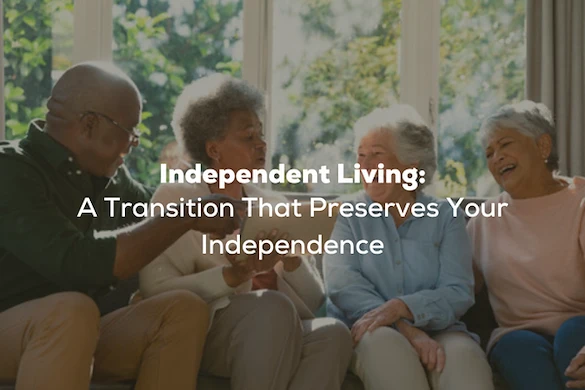
That boundary is exactly why the level exists. It is also why the distinction from assisted living matters: if your parent needs hands-on help with bathing, dressing, mobility, or medication, independent living will not provide it, and choosing it anyway usually means moving twice. Our piece on independent living as a transition that preserves independence sits with the emotional side of that, and the five myths of independent living takes on the assumptions that get in the way.
It suits someone who manages their own personal care, is finding the house more burden than pleasure, and would benefit from people being closer. It suits couples where one is starting to shoulder more of the household than is reasonable. It suits people who move while they still have the energy to make friends, which is the single most common piece of advice residents give and the single most commonly ignored one.
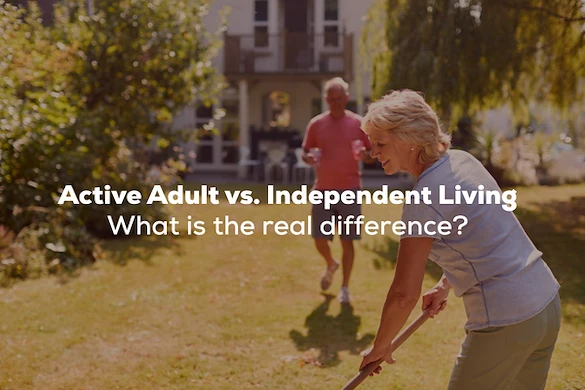
It does not suit someone who needs daily hands-on help. That is assisted living. It also does not suit someone who wants a house without a yard and nothing else, which is closer to active adult living, an age-restricted housing product with fewer bundled services and usually no dining plan. Those two get confused constantly, and the difference shows up in the monthly rate.
One honest caution. Independent living is a private-pay arrangement, and the monthly rate replaces some costs you already carry rather than adding entirely to them: the mortgage or upkeep, the utilities, the groceries, the car. Doing that arithmetic properly is worth an evening, because the comparison is rarely as unfavourable as the sticker suggests and occasionally worse. Our overview of independent living costs by state gives a sense of the range.
How to test it before deciding
Visit at a mealtime, not at ten in the morning. The dining room at noon tells you more about a community than any tour route will.
Talk to residents without staff present. Ask what they wish they had known, and ask what they would change. People are candid, and the answers are usually specific.
Ask about the forward question even though it feels premature: if personal care is needed later, can it come to the apartment, or does it mean moving? Communities answer that very differently and the answer should shape the choice now.
And take the guest suite if there is one. A weekend in a community answers questions that no amount of touring will.
When you are ready to compare properly, search independent living near you and ask each community for its inclusions list in writing. Senior Care Finder is free for families, no login required, and the conversation stays between you and the community.